
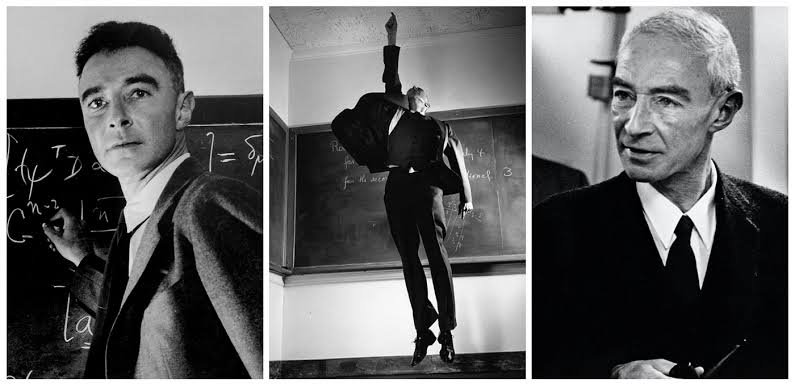
On July 21, 2023, a highly anticipated movie titled “Oppenheimer” will grace the silver screen, and everyone is eagerly awaiting it. Count me among those who can hardly contain their eagerness, especially because it is a Christopher Nolan film. The name “Christopher Nolan” alone is enough to generate excitement, but there is another name associated with it that further enhances the anticipation – Julius Robert Oppenheimer. So, let’s explore who J. Robert Oppenheimer is: a hero or a cult figure. Let the exploration begin!
Early Life and Education
Born on April 22, 1904, in New York City. Little did the world know that this curious child would grow up to become one of the greatest scientists in history. As a young boy, Oppenheimer displayed a deep curiosity for the world around him. He loved books and had a passion for astronomy, often gazing at the stars through his telescope.
This inquisitive nature makes him study physics at Harvard and later earned a Ph.D. from the University of Göttingen in Germany. However, in 1930 he became very active in science, especially in theoretical physics.
The Role in the Atomic Bomb
In the 1940s, during the course of World War II, the American government became aware of Germany’s nuclear program. It was on December 7, 1941, following the attack on Pearl Harbor, that the United States officially entered the war. In 1942, American President Franklin D. Roosevelt made a crucial decision to initiate research on nuclear technology, with the aim of developing an atomic bomb.
So, Oppenheimer was selected to lead the Manhattan Project, a top-secret mission to develop the atomic bomb. Alongside a team of brilliant scientists, he worked to unlock the mysteries of nuclear fission and create a powerful weapon.
However, in order to keep the project confidential, the United States established a research facility in Los Alamos, New Mexico. J. Robert Oppenheimer was appointed as the director of this facility.
On July 16, 1945, after three years of hard work, they successfully conducted the test of the atomic bomb, known as the “Trinity test.” After that, the Potsdam Declaration was issued on July 26, 1945, by the United States, the United Kingdom, and China, also known as the Allied Powers, during World War II. It was addressed to Japan, specifically to the Japanese government, as an ultimatum to surrender and end the war. The declaration was issued after the Allies’ meeting in Potsdam, Germany, where they discussed the terms for Japan’s unconditional surrender.
In the Potsdam Declaration, the Allies outlined the conditions for Japan’s surrender and warned of “prompt and utter destruction” if Japan did not accept the terms. The declaration called for Japan to accept the principles of unconditional surrender, which meant surrendering without any conditions or negotiations.
After Japan refused to surrender, the United States made the decision to use atomic bombs as a means to bring an end to World War II. On August 6, 1945, the first atomic bomb was dropped on the city of Hiroshima, and three days later, on August 9, 1945, another atomic bomb was dropped on Nagasaki.
The bombings of Hiroshima and Nagasaki resulted in unprecedented devastation and loss of life. The immediate impact of the bombings caused massive destruction, killing tens of thousands of people instantly and injuring many more. In the following weeks, months, and years, the effects of radiation exposure led to further casualties and health issues for survivors.
After that bombings, World War II ended on August 15, 1945, in the most destructive way possible and raised profound moral questions for Oppenheimer. Seeing the immense devastation caused by his creation, he started supporting international control of nuclear weapons and emphasized the importance of peace and cooperation among countries. His famous quote “Now I am become Death, the destroyer of worlds” reflects his profound reflection on the bomb’s destructive power, and this line originates from the Bhagavad Gita.
Relation with the Left
Oppenheimer’s association with leftist political groups in the past led to scrutiny during the post-war era. Accused of having communist sympathies, he faced a difficult period during the “Red Scare” and was subjected to investigations by the government. Despite this, his loyalty to his country remained unwavering, and he continued to contribute to science and national security.
Legacy and Impact
In the years that followed, Oppenheimer became a symbol of the power and responsibility of scientific discovery. He advocated for open scientific inquiry and academic freedom, nurturing future generations of scientists.
Conclusion
J. Robert Oppenheimer was a brilliant scientist filled with regrets. His life was a journey of intellectual exploration, discovery, and moral reflection. From his early passion for science to his crucial role in the development of the atomic bomb, he left an indelible mark on the world. Despite facing challenges and controversies, his legacy endures as a reminder of the complexities and consequences of scientific advancements. He serves as an inspiration to us all, encouraging us to harness knowledge for the greater good and promote a peaceful world.